
Share this
by Myzone on Tuesday, 24 January 2017
As a Myzone user, you’ve probably heard the term “maximal heart rate.” Sounds pretty self-explanatory, right? But when you begin to think about the term a little more, what does maximal heart rate (MHR) really mean to us as exercisers? Let’s peel back some of the layers of MHR.
What is MHR and how do we measure it?
According to the Mayo Clinic, MHR is “the upper limit of what your cardiovascular system can handle during physical activity.”
The gold standard for maximal heart rate monitoring is to perform a graded exercise test on a cycle ergometer or treadmill supervised by a cardiologist or exercise physiologist. In a graded exercise test, the work rate is gradually increased until the exerciser is unable to continue exercising. Maximal heart rate is considered the highest heart rate attained during the test.
Graded exercise tests are typically used in clinical settings to evaluate how your heart responds to exercise. Though often used to determine underlying cardiac conditions, these tests can be used to determine appropriate intensities for aerobic exercise.

Why and how do we estimate MHR?
While a graded exercise test is the most accurate way to determine MHR, they are not usually accessible to the average exerciser. As such, prediction equations have been developed to estimate MHR.
Myzone uses the equation: MHR = 211 – (0.64 x age in years)
When you enter your age during the registration process, Myzone automatically calculates your MHR. It’s important for you to have a MHR value in the Myzone system, as Myzone uses it to determine your heart rate zones while working out.
How does MHR relate to the Myzone zones?
The Myzone zones (GRAY, BLUE, GREEN, YELLOW, & RED) are directly tied to your estimated MHR in the Myzone system. Here’s a breakdown:
- GRAY Zone: 50-59% of MHR
- BLUE Zone: 60-69% of MHR
- GREEN Zone: 70-79% of MHR
- YELLOW Zone: 80-89% of MHR
- RED Zone: 90-100% of MHR
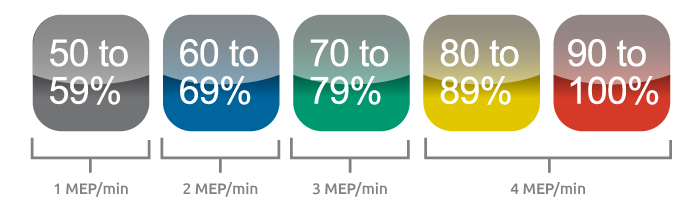
As you can imagine, an incorrect value for MHR will impact which zone you are in during your workouts. We’ll describe when and how to adjust your MHR later in this post.
What are some factors that affect MHR?
- Age: our MHR tends to decrease as we grow older.
- Altitude: Acute exposure to high altitude may cause a temporary decrease in our MHR. We will also have a higher heart rate during submaximal exercise at a high altitude. With continued exposure to high altitude, our MHR should increase and our heart rate during submaximal exercise should decrease compared to when we were first exposed to high altitude.
- Mode of exercise: The MHR we can achieve during different exercise modalities does vary to some extent. For example, exercisers tend to achieve a higher MHR when running compared to cycling due to more muscle mass utilized in running. Exercises like swimming and upper-body Kranking may also elicit a lower MHR due to the smaller muscle mass of the upper body. We recommend that you set your MHR value to be appropriate for the modality of exercise you perform most often.
- Medications: Some medications will limit the MHR you can and should achieve during exercise. An example is beta blockers, which decrease your MHR lower than the age-predicted maximum used by Myzone. Be sure to ask your doctor if any of your medications will impact your MHR.

How do I know if my MHR is wrong in the Myzone system?
Although the estimated MHR equation used by Myzone should be accurate for most people, you may need to adjust your estimated MHR somewhat. You’ll be able to determine this by comparing your rate of perceived exertion (RPE) to your Myzone zone during exercise. Check out this video for details on RPE and for a simple assessment you can perform to determine if you need to change your MHR.
A general rule of thumb is:
If your RPE indicates low-to-moderate intensity exercise but your zone indicates high intensity exercise, you need to raise your MHR. Ex: you feel like you are working at a 6 but you are in the YELLOW zone.
If your RPE indicates high intensity exercise but your zone indicates low-to-moderate intensity exercise, you need to lower your MHR. Ex: you feel like you are working at an 8 but you are in the BLUE zone.
How do I adjust my MHR in the Myzone system?
If your fitness facility uses Myzone, your trainer or fitness manager will be able to adjust your MHR on the Partner Page of Myzone.org. If you don’t belong to a fitness facility, or if they don't have Myzone yet, you can contact Myzone support at https://myzonesupport.zendesk.com/hc/en-us and ask them to adjust your MHR.
Keep in mind, if you hit a heart rate value above your estimated MHR during your workout and maintain it for at least 30 seconds, Myzone will automatically update your estimated MHR to the new number you achieved.
In certain cases, you may need to set a limit on your MHR so that you exercise at an intensity that is safe for you. We encourage you to talk to your doctor about exercise and see if you should not be exercising above a certain heart rate. If this is the case, you can ask an employee at your fitness facility to set a MHR limit for you, or you can contact Myzone support.

If you have questions about MHR, we want to know! Connect with us on social media using the hashtags #myzonemoves and #effortrewarded. To hear Myzone Master Trainer Ayla Donlin discuss maximal heart rate monitoring, watch our recent Fitness Friday broadcast.
For more tips on how to use Myzone to achieve your fitness goals, follow us for our Fitness Friday broadcasts on Facebook Live (subscribe on Myzone’s Facebook page) every Friday at 8 am PT, 11 am ET.
Keep moving forward!