
Share this
by Myzone on Thursday, 16 June 2016
Wondering how to best utilize MYZONE when training your clients? We’ve got some tips for you, including a simple assessment that you can perform in less than 10 minutes to assess your client’s heart rate recovery!
In a previous post, we described heart rate recovery and how it is an indicator of cardiorespiratory fitness. With proper aerobic training, your client’s heart rate will be able to decrease more quickly following a bout of moderate or high intensity exercise. You may observe that your client has trouble recovering their heart rate from the YELLOW to GREEN zone within one minute at the beginning of their training, but they are easily able to make that same decrease in less than a minute after several weeks-to-months of training with you.

How do we track and quantify heart rate recovery over time using the MYZONE system? The following assessment is something you can use with your client for just about any type of aerobic exercise. Here’s how it works:
What You’ll Need:
A stopwatch or easily visible clock (like the one on your facility’s MYZONE display)
A pen & chart to record data
A stationary bike, treadmill, elliptical, step, or other setup for the aerobic exercise your client will perform
The Protocol:
Ask your client to sit quietly for a minute or two. Once their heart rate has stabilized (isn’t moving up or down), record the heart rate value on the MYZONE display. This is their ambient heart rate – their heart rate when they are restful (not the same as resting heart rate).
Have your client perform a 2-minute warm up in the GRAY or BLUE zone. Within the final 10 seconds of each minute, record your client’s heart rate and their rate of perceived exertion (RPE) on a scale of 1-10 (1 being very very light, 10 being very very challenging).
Over the next three minutes, instruct your client to gradually increase the intensity of their exercise by increasing their workload (i.e. speed, resistance, incline) so their heart rate passes into the BLUE, GREEN, and YELLOW zones. Allow one minute per zone. Continue to record heart rate and RPE in the last 10 seconds of every minute.
Once your client has reached 85% of their maximal heart rate, instruct them to sustain this intensity. Keep your client at 85% for one minute and record heart rate and RPE in the last 10 seconds of the minute. The heart rate value you record is their submaximal peak heart rate.
Instruct your client to immediately cease exercise and sit down for one minute (if they are already sitting on a stationary bike, they can remain seated). Record heart rate and RPE in the last 10 seconds of the minute. The heart rate value you record is their recovery heart rate.
Find the difference between your client’s submaximal peak heart rate and recovery heart rate. This is a value you will track over time.
Repeat this assessment in 6-8 weeks.
As your client becomes more aerobically fit, their recovery heart rate should decrease and the difference between their submaximal peak heart rate and recovery heart rate should increase.
Seeing a decrease in recovery heart rate and a bigger difference between submaximal peak heart rate and recovery heart rate indicates that your client’s heart is becoming more efficient at responding to the stress placed on it.
Here is a sample chart from a heart rate recovery assessment we performed:
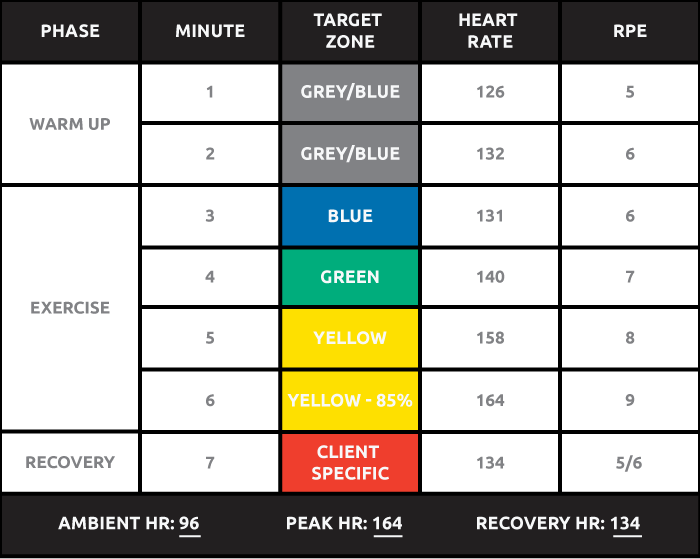
As you can see, Ayla’s heart rate steadily increased during the warm up and exercise phase of this assessment. During the recovery, both her heart rate and RPE decreased. The difference between her submaximal peak heart rate and recovery heart rate is 30 beats per minute. In her next assessment, we’ll see if this number has increased.
To see Ayla’s full assessment, check out this Youtube video.

Considerations:
In general, we can expect to see our client’s submaximal heart rate decrease over time at any given workload. After consistent training, they will have to increase their workload in order to reach the same heart rate. This will not affect the assessment protocol we’ve described – you might just have to instruct your client to increase their workload higher than the last time they performed this assessment to reach 85% of their maximal heart rate.
It is ideal to perform assessments under consistent conditions. If your client first performs this assessment at 9 am, one hour after eating a light breakfast, and after eight hours of sleep, you should keep these variables as similar as possible during the subsequent assessments. To learn more about factors that affect heart rate, see this post.
We recommend performing this assessment every 6-8 weeks with your client to check in on their progress. Please note that as your client becomes more and more fit, their improvement margins are likely to become smaller and smaller. This is a good thing as it indicates they are getting closer to their genetic potential. Keep revisiting your client’s goals each time you perform this assessment.
We hope this assessment is useful when training your clients. We want to see how you’re using MYZONE during your training! Post to Facebook, Twitter and Instagram using the hashtags #MYZONE, #myzonemoves, and #effortrewarded.
For more tips on how to use MYZONE when training your clients, follow us on our Fitness Friday Periscope Broadcast every Friday at 11 am EST, 8 am PST. Keep Moving Forward!