
Share this
by Myzone on Tuesday, 10 May 2016
If you’ve ever used MYZONE while in your group fitness class, you know it adds excitement, structure, and motivation that surpasses any other technology out there. Turn on your group display during a class, add your expertise and personality, and your class is going to be good. For group heart rate tracking there is no solution on the market that is more accurate or dependable than MYZONE.
But how can we use MYZONE to make our group fitness classes great? After several years of using MYZONE in our group fitness classes, we’ve developed a list of our best practices for using this fantastic technology in any group fitness class, regardless of the class format. Check out this list–full of our tried-and-true tips for you!
Group heart rate tracking and safety
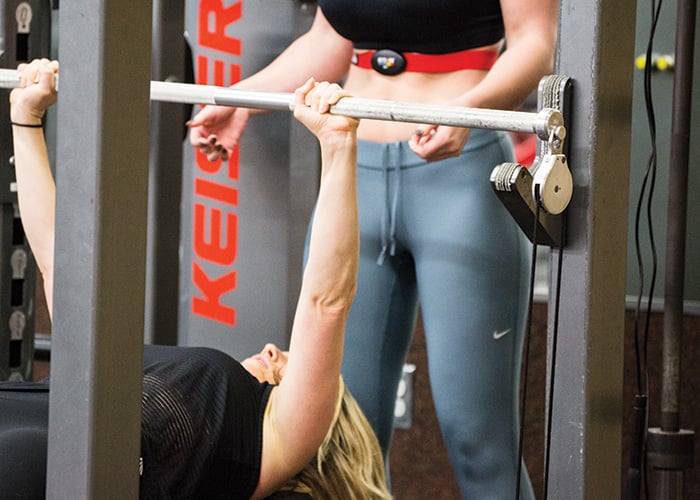
Our MYZONE heart rate monitor is an accurate way to track live heart rate data, but if a class member’s maximum heart rate is incorrect, their percent of maximal heart rate (%MHR) will not reflect how they feel during class. Additionally, there is always a chance that a class member may fall ill during the class, or that they may not listen to their body despite warning signs that they need to take it down a notch.
If you notice that someone is hanging out in the red after the work interval is over or that their heart rate drops dramatically, check in with them to make sure they are feeling ok. If they are in red but feel like they are at a moderate intensity, you will be able to adjust their maximum heart rate in your Partner Account after class.
To prevent our class members from pushing themselves beyond safe limits, we take a moment at the start of class to make sure safety is the number one priority. Often times, we’ll frame it like this, “I want you to challenge yourself today, but I also want you to listen to your body. If you’re feeling lightheaded, thirsty, or as though you’re unable to recover your heart rate, please take the recovery time that you need to stay safe.”

Explain the relationship between %MHR and RPE
Rate of perceived exertion (RPE) is a tool that you can easily cue your clients on, and it conveniently relates to the %MHR that MYZONE provides. The benefit of using RPE in addition to the live data provided by MYZONE is twofold - class members with a MYZONE belt have multiple points of reference for the intensity of their workout and class members without a MYZONE belt still get to participate in the class (of course, you can educate them on the importance of having a MYZONE belt during and after class).
A convenient way to relate %MHR and RPE is to use an RPE scale of 1-10, 10 being the maximal amount of effort members can give, and 1 being minimal effort. As a general rule, the 10-point scale directly relates to %MHR on the MYZONE system (i.e. a class member who is at a 6 on the RPE scale is usually floating around 60-69% MHR).
If a class member’s RPE does not align with %MHR, it is possible that their MHR needs some adjusting. Here’s an easy rule of thumb when you adjust MHR:
If a member’s RPE value is lower than their %MHR, you may need to increase their MHR in your MYZONE Partner Account.
If a member’s RPE value is higher than their %MHR, you may need to decrease their MHR in your MYZONE Partner Account.
Explain Why Heart Rate Isn’t One-Size-Fits-All
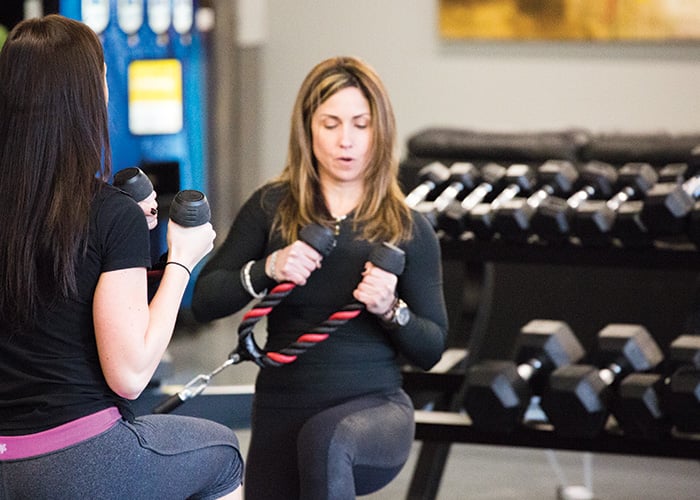
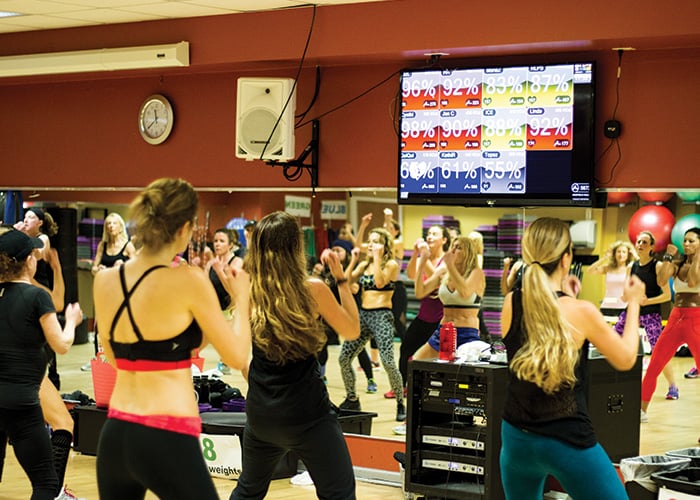
The variability between class members when group heart rate tracking speaks to why we toggle to %MHR as the main data point on the tiles of our group display. This way, members can still see their actual heart rate value during class, but their main focus is on the relative intensity, or effort, of their workout in the form of %MHR. If members’ main focus was on absolute heart rate, we might find members judging the success of their workout based on how their heart rate compared to other class members – and we know that heart rate isn’t one-size-fits-all.
We like to use this as a talking point in class to educate our members on heart rate, MHR, and how heart rate varies person-to-person. Not only does this allow us to have intelligent and productive conversations with our group heart rate tracking class members about their exercise intensity; it also increases their engagement, understanding, and experience.
Check out one of our previous posts to learn more about factors affecting heart rate.
Program Your Classes with Heart Rate Recovery in Mind
The speed at which our class members’ heart rates decrease during a recovery period or during the cool-down may vary greatly. A highly-trained exerciser’s heart rate may recover very quickly, while a novice exerciser’s heart rate may decrease very slowly. How are you as the instructor supposed to program for the athlete, the novice, and everyone in between?!
Although it depends on how you want to design your classes, our general recommendation is to err on the side of slower heart rate recovery. This means that after a “push” or a work interval, be sure to give your class members enough time to recover their heart rate to the zone you have selected. Some members’ heart rates may drop almost immediately, while others’ may take a minute or more.
To give you specific examples of what we mean, let’s pretend that you’ve just finished a group heart rate tracking interval during which most class members’ heart rates were in the upper yellow zone. In the recovery phase, you can…
Extend the recovery phase to be long enough for everyone to recover into the zone you’ve selected (probably green or blue).
Give members “speeding tickets” – if their heart rate hasn’t recovered to the designated zone before the next push, they must wait until their heart rate recovers before rejoining the group heart rate tracking class.
Give members a recovery range. For example, instruct members to take 30-60 seconds to recover their %MHR by at least 10%.
Gauge a Successful Workout by More than Just Calories
Ever heard a group fitness class member finish up the workout and say, “What a great workout; I burned 800 calories!” or “That workout felt great but I burned fewer calories than last time; maybe this class isn’t for me”?
While calories are certainly important in weight management, we know that burning them isn’t the only reason why we exercise. We also know that we can’t gauge the success of a person’s entire fitness program based on the calories burned during one group heart rate tracking session (calories expended and consumed over the long term are better indicators). Encourage your participants to look at their Activity Calendar on their MYZONE App and check in with their monthly caloric expenditure and MEPs earned. Create a culture that rewards consistency and adherence rather than acute success.
MYZONE provides so much more valuable feedback than caloric expenditure alone - MEPs, heart rate recovery, average effort, time spent in each zone, and more! We recommend taking a little time during each class to explain what MYZONE is showing us (i.e. what’s on the class members’ MYZONE tiles and why that information is important). Your class members will be better educated on heart rate training and will ultimately feel more successful after their workouts.
We hope these tips come in handy when you’re planning for your next group heart rate tracking class. We want to see how you’re using MYZONE during your classes! Post to Facebook, Twitter and Instagram using the hashtags #MYZONE, #myzonemoves, and #effortrewarded.
For more tips on how to use MYZONE when training your clients, follow us on our Fitness Friday Periscope Broadcast every Friday at 11 am EST, 8 am PST.
Keep Moving Forward!